
Mortar—Christopher Shipman
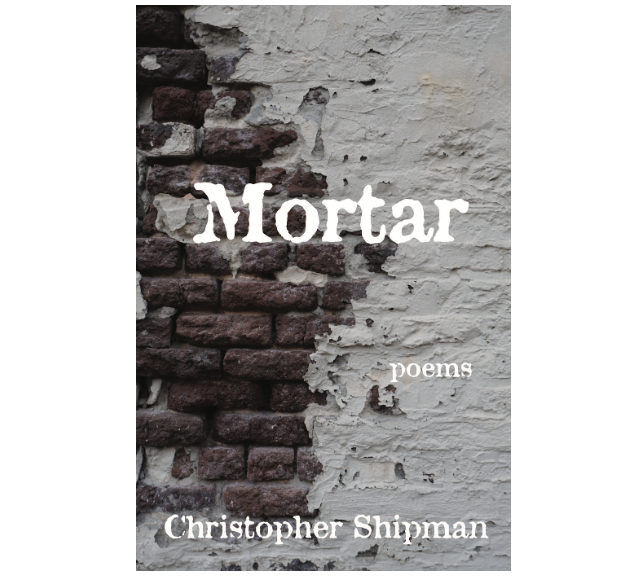
Mortar—Christopher Shipman
Domestic Shipping: $4.00 plus $1.00 for each additional item
International Shipping: $17.00 plus $2.00 for each additional item
Publication Date: November 29, 2025
Publisher: Brick Road Poetry Press
Language: English
Print ISBN: 978-1-950739-14-1
Product Dimensions 6in x 9in x 0.3in
Shipping Weight: 0.392lbs
“I’ll tell the story. Tell it delicately,” Christopher Shipman promises in his astonishing collection of poems, Mortar. In poem after poem, Shipman defies the contours of elegy to explore how loss becomes the mother of other losses. A grandmother murdered by her husband’s brother. An estranged father holding the brick of death in his mouth. A son confronting his family’s spectrum of devastation while raising a daughter of his own. Mortar is the book I needed to read when I was first trawling the river of my own grief. Shipman does more than tell the story of loss. He tells the story of longing. He tells the story of love.
–Sara Henning, author of Burn, Terra Incognita, and View from True North
In Mortar, Christopher Shipman confronts the legacy of his grandmother’s murder and the weight it presses across generations. Moving by accretion—prose, lyric, and fragmented poems, each layering fact, dream, and invention—the collection returns to the brick with incantatory force, at once the weapon of the crime and the figure of its aftermath. “The night is long, I mean generations,” Shipman writes, and the poems enact that long night’s tension, always approaching the house of the murder, always on the verge of witnessing the violence itself, “like the scene in the movie that scatters birds.” Alongside these hauntings, life persists: a father with his daughter, a husband pursuing simple dailiness. Restless, inventive, and tender, Mortar transforms trauma into lyric witness—a fearless book haunted by what it cannot release.
—Kerrin McCadden, author of American Wake
Bricks, like humans, are formed from clay, heated to an unbearable temperature, until "the clay / breaks down / becomes / molten— / a deformed shape—", like the self after unbearable trauma. Mortar—this brilliant and innovative, book-length conceit—examines both kinds of clay, the literal and the figurative, holding the building blocks of self together with a virtuosic array of poetic strategies, from prose poems that unfold in a fluid rush of powerful emotion, to brief, perfectly formed kernels so intensely compressed they seem to have been fired in a kiln. A tour de force from a poet at the height of his powers.
—Bill Lavender, author of My ID and city of god
On the surface, Christopher Shipman's Mortar is about a family within a murder. Entry to a house, where the reader will absorb the sadness of the ghosts inside, all wearily waiting for permission - to be done with haunting. A permission the author then grants by giving a name to everything he loves. Every page, every poem, like a heart, committing, to continue, pumping. Blood - thicker than a brick. This isn't the pretending you do until you find your way. This is the work of a life. Not just the words. But the undertaking. It's not so much the courage it takes to enter a haunted house. But the courage it takes to open the door, and see what it means. To finally leave. A necessary attempt, to embrace the truth of being alive in the face of "what sent the before into after." Or to at least make sure your daughter knows what the light feels like outside that shadow.
—Lonnie Ray Atkinson, author of Tough Guys, Bad Dudes, and Other Men My Father Knew
“Poet Christopher Shipman on Absence and Poetry as Medicine”an interview with Christopher Shipman by Anthony Calzia, Jr. on Mortar